Allowing kids to walk or bike to school has multiple benefits. It keeps kids healthy by getting them outdoor exercise, it gives them more independence, it gives parents more free time, and it saves parents money on gas. But kids will only do this (or be allowed to) if it is safe and accessible. So why are we making walking/biking to school dangerous by designing schools primarily for car drop off/pickup?
My step daughter goes to Morris Elementary/Middle School, and will eventually attend Columbia High School, so I will focus mostly on those schools, but this can be used as a benchmark for other Huntsville schools.
Morris Elementary/Middle
Morris Elementary/Middle is along a straight wide 5 lane road. Roads like these encourage high traffic and fast speeds. This makes the road more dangerous, which encourages more parents to drive their kids to school, which in turn increases car traffic, which makes the road more dangerous, and so on. Its a bad cycle that needs correcting.

There are a few ways to improve the situation, including things already being planned by the city. One thing the city is planning to build is a new road that more directly connects 565 with Gate 8 and 10. This will greatly reduce thru traffic in front of the school, especially during the morning.

The new roadway would be pricey, but considering multiple other roadway projects in the same report are valued at $40m or even $50m, $35m isn’t out of line.
This would help reduce traffic on Bob Wallace and Jordan Lane, but there is more that can and should be done, and for a lower cost.
First, the timer at the crosswalk should be changed to reduce the wait time to cross the street. Currently, it takes 50 seconds for the signals to change after pressing the crosswalk button. With the current long wait time, some kids don’t even wait, they cross the street before the signals change, or don’t even cross at the crosswalk at all. It makes little sense to force kids to wait in the heat, while people in their air conditioned cars get priority. The signal should change within ~5 seconds of the button being pressed.
Second, one of the best ways to increase safety is to reduce the number of car lanes. I think this is something that can be done temporarily and, if there is positive feedback, make it a permanent change.
For the beginning, one lane of each side of the road in the school zone should be blocked off during school hours (7:30am to 3:30pm). Below is a mockup I created to demonstrate this

The intersection on the left is where drivers go to drop off their kids by car. The right intersection is where staff and school busses enter/exit. Its also where students cross to enter/leave the school on foot.
The yellow lines represent cones. These cones will be set up by the two crossing guards each morning. The cones can be placed in a wagon and easily rolled out and set up on the streets each morning and removed after school ends and everyone has left.
The blue lines represent thru traffic. The green lines represent school traffic. The blocked section will get drivers to slow down and make it safer for kids to cross, while also having minimal impact on traffic. Thru traffic will still have its own lanes, while school traffic will also still have its own lanes too.
The purpose of this is to reduce the lanes from 5 lanes to 3. Reducing lanes like this makes it safer for kids to cross, as it will be fewer car lanes they have to cross. This also narrows the road, forcing drivers to pay more attention to the road and slow down. Drivers are forced to be more alert when road conditions physically change like this. Its much easier to ignore a school zone sign than to ignore cones in the road and a narrowing road.
This is something that will need to be enacted the ENTIRE school day. Currently, crossing guards and reduced speed limits are only active at the intersections during the start and end of school. This is a problem because its not the only time students enter or leave school. Kids are sometimes late, or they have to leave school early. By leaving the cones in place all throughout the school day, this ensures its safe for students to cross at any point in the school day.
Third, long term, some of these changes should be made permanent. Lets first take a look at the school zones

The orange section is the Morris school zone for elementary students. The school is also a middle school, and the middle school includes the Ridgecrest zone, shaded in brown. When you include the Ridgecrest zone for middle school, you can see most of the residential areas are to the east of the school. There are some neighborhoods to the west, but most of that area is made up of the UAH campus. Because of this, I think its best to focus on the east side of the zone to improve walking and bike safety for students, as few would be walking or biking from the west.
Here are my suggestions:

Green line is where a protected bike lane is currently placed. The blue line is where the new bike path will begin. Lets zoom in.

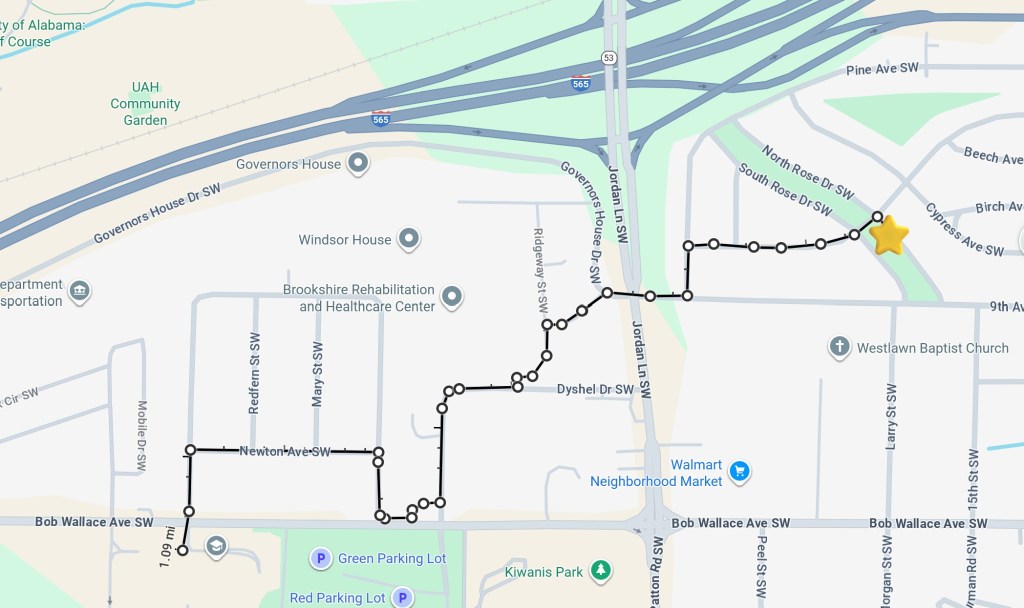
At this intersection, cyclists will come off of Governors House Dr and 9th Ave and enter into the path marked as blue. This blue line is current a sidewalk, but should be transformed into a multi-use path. This can be done by simply widening the sidewalk. There is plenty of space to do that at this location. Cyclists would then turn onto Dyshel Dr, which is a residential street.
Next, they will turn onto Bob Wallace

Here is where one lane of road would be turn into a protected bike lane. This will create a safe cycle route around this entire neighborhood and connects the school to the neighborhoods of Westlawn, Stovehouse, Westfield, and Lowe Mill.
For the middle school students zoned in Ridgecrest elementary, we’ll do something similar.

A Traffic signal/pedestrian crossing will be added at Coffee Dr to allow cyclists from that neighborhood cross into a path that leads to Kiwanis Park. They would then bike to the sidewalk along the side of Bob Wallace to school. The sidewalk will be converted to a multi-use path. This location also has ample space to widen the sidewalk into a multi-use path.
For reference, the distance by bike between Ridgecrest Elementary and Morris Middle School is only 1.7 miles, or an 8 minute journey. This is a perfectly reasonable distance for a middle schooler.

This path is not only useful to going to Morris Elementary, it also gives a safe way to bike to Kiwanas Park and Huntsville Botanical Garden.
Columbia High School
I will briefly talk about Columbia High School. This is the school zone for Columbia High School

Already, its obvious that walking or biking to school isn’t even remotely feasible. But it gets worse.

There is only ONE neighborhood within a mile from the school. Only 3 neighborhoods within 2 miles. These are small neighborhoods too. The amount of kids reasonably capable of walking or biking to this high school is near 0%. Putting a school in the middle of a research park has to be one of the dumbest things the city has done. Schools should be places near families, not near offices.
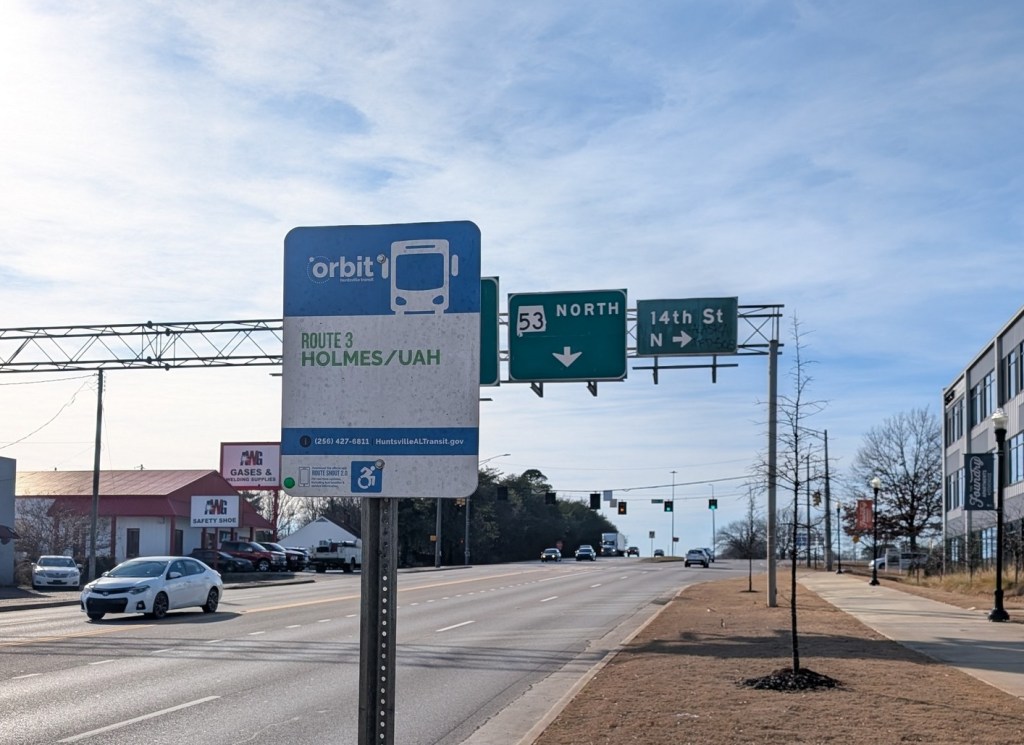
On top of that, there is no city bus stops near this school. This means that school bus or car is the ONLY way most people will be able to access this school. A city bus stop near/at the school would a huge benefit to students at the school.
Why not just take the school bus?
This is a reasonable question. If you have read this far, you may be thinking, well, if you want alternatives to driving, why not use the school bus? School buses are a good alternative to driving, but its not enough as being the only alternative. There are multiple reasons to why someone may not be able to take the school bus.
First, the school bus officially will only pick up elementary students over 2 miles away from school, or high school students over 5 miles away. This means that a high school student living 3 miles from school would be forced to be driven to school, as there would be no other reasonable alternative. 3 miles is roughly a 15 minute bike ride, but with no bike infrastructure, it wouldn’t be a safe journey.

I do see a school bus for Morris elementary pick up students around 1 mile from school. My guess its because its on the road going back to school anyways. They will pick up kids less than 2 miles from school as long as the students are standing by the road on the bus’s route back to school.
Second, the school bus ONLY runs at the start and end of school. Anyone who wakes up late would not be able to take the bus. Its also possible for the bus to be late. For some reason, at least one school bus at Morris is regularly late, not arriving to the school until around 8:05am. Students wanting to arrive early to school to eat breakfast will be out of luck if they take the bus.
This is also a problem for students who participate in after school events. They will have no way home once the bus leaves.
Third, students can’t just hop on the bus. Parents must first apply for their kids to get on a bus route. Bus routes can also change and are not publicly posted. This makes riding the bus infrequently problematic. Imagine if you take your child to school by car every day, but one day your car doesn’t start. With the way the school bus system works, it could be impossible to get your child to the school bus without knowing the exact time and location the bus stops.
Schools should supplement school buses with regular city buses. Every middle and high school should have a city bus stop. Students should receive free city bus passes.
These changes will give more freedom and flexibility to families across the city. We can do so much more to improve the safety for our kids and to reduce the expensive reliance on cars.
I was recently interviewed by the local news to talk briefly about the Huntsville police “Zero in the Zone” school speed limit policy. That, along with school starting back, inspired me to write about this. I wanted to get my full thoughts out on the matter. You can watch the video below

 Strong Towns Huntsville
Leave a comment