The first annual North Alabama Regional Transportation Summit was created by Launch Regional Partnership, which is an off-shoot of Committee of 100, and both lead by John Allen.
Thanks to the contributions from our supporters, I was able to attend the event and report what happened and what was discussed.
Opening Session
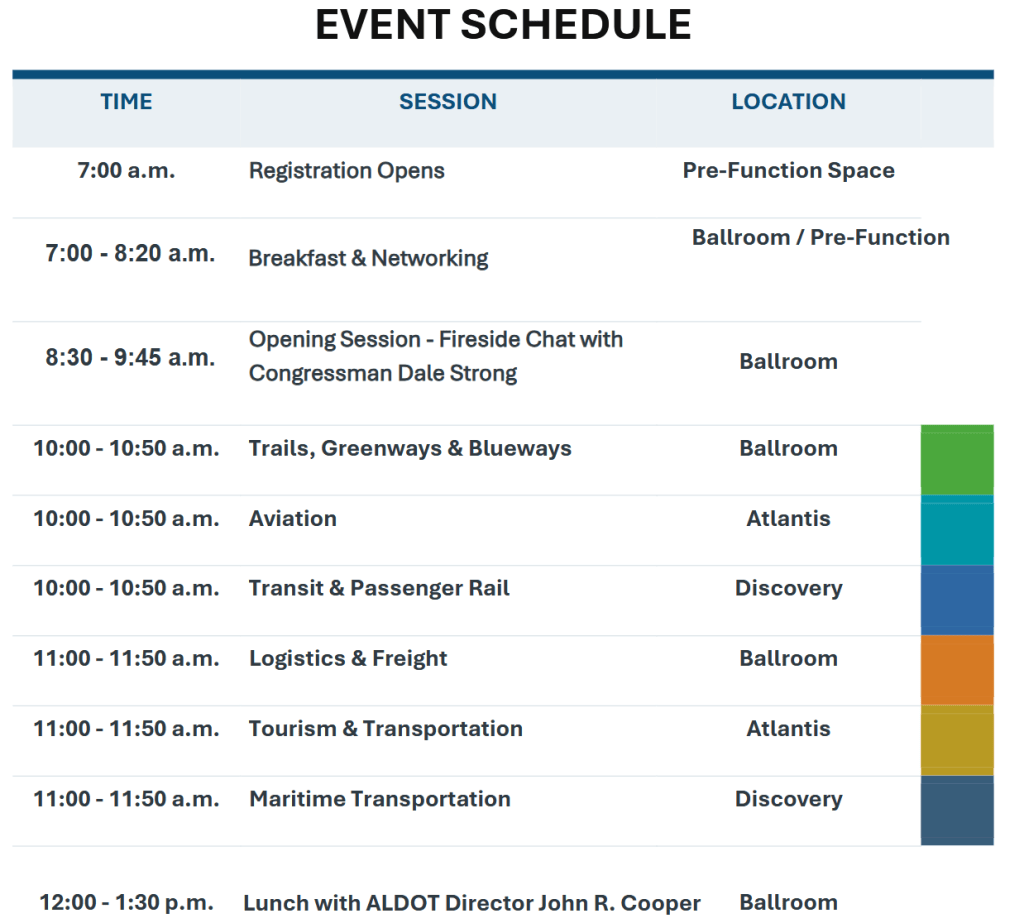
Monday’s event started off a little disorganized with the schedule shifting around at the last minute, and actually started earlier than originally scheduled. It started off with a “Fireside chat with congressman Dale Strong”.
If you know Dale Strong, the chat went about how you’d expect. The host asked a few transportation related question, and Strong would briefly begin to answer the question and then start rambling about how focused he is on North Alabama, his accomplishments, and other campaign talking points. He ranted for several minutes about how overblown the issues of data center’s power and water usage is, and how great the Meta and Google data centers in North Alabama are. He mentioned “the southern border is now closed”, and he ends by encouraging people to vote.
The opening to the event was essentially a campaign rally for Dale Strong with little actually said regarding transportation, other than to ask city and county leaders to apply for grants so we can get more federal government funded projects.
Transit & Passenger Rail panel
Next up were the greenways, aviation, and transit panels. With all 3 being at the same time, I could only choose one. Being more focused on urban developments, and the greenways more focused on the rural singing river trail, I chose to attend the transit panel.
The transit panel was made up of representatives from the city of Huntsville, city of Decatur, and Madison county.
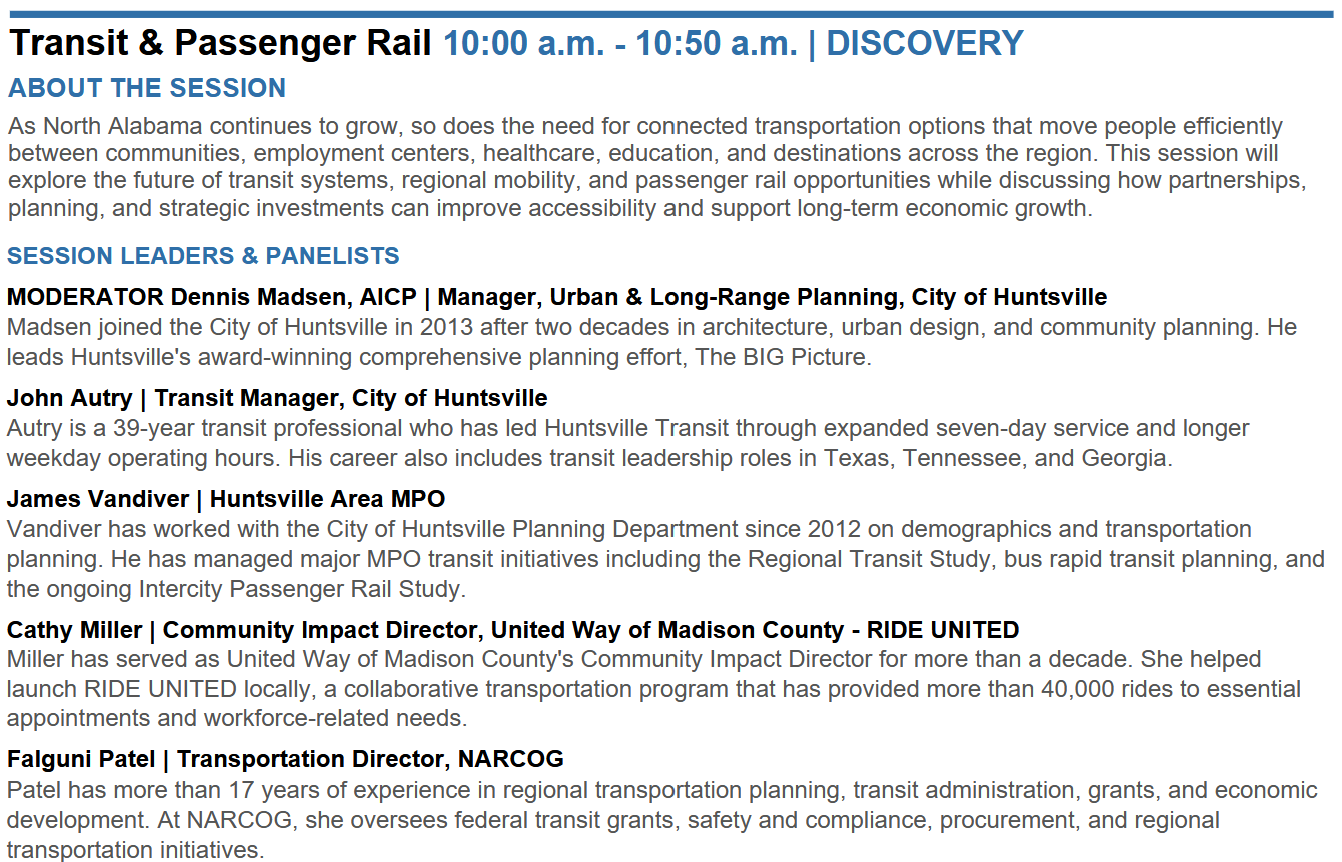
Dennis Madsen was the host of the panel and my first impression was, wow, Madsen is a great panel host!
The panel started off with introductions, including an opening question to the panelists: What is your favorite transit system? Here is how they each responded:
Autry: Washington DC and the University of Georgia
Vandiver: Vienna, Austria and Washington DC
Miller: Huntsville Transit and MARTA/Atlanta
Patel: Barcelona, Spain
Madsen: Atlanta Airport
A great introduction question that lets us see the frame of reference local transit leaders have for what great transit looks like.
New to me was meeting Cathy Miller and learning about Ride United. We spoke before the panel and I learned more about it during the panel too. Ride United functions similar to Huntsville Access in that its a demand-response form of public transit, but unlike Access, Ride United is available to more than just those with disabilities.
Ride United is a free service that helps those with short term needs of transportation, particularly those who need transportation to attend job interviews and the first few weeks of starting a new job. This helps people get an income while they save up to get their own transportation or to spend the money fixing their car.
This service not only helps people, but also shows the demand for more permanent public transit routes. Demand has increased significantly over time. Already, the service has provided 40,000 rides throughout Madison county. Because of this and a recent budget increase, they are planning to expand service soon.
They are funded primarily through grants and partnerships with businesses and governments whose employees rely on the service.
The panelists discussed how demand is increasing for public transit in Huntsville. ~25,000 people in Huntsville don’t have a car and rely on alternative means of transportation, such as public transit. In April this year, during a 2 day period during Panoply and multiple large events happening at the VBC, the city ran one bus line with a frequency of 5 minutes and had 4,000 riders in just those 2 days.
When it comes to passenger rail, the study that started a few months ago has progressed and it’s likely to find Huntsville to Birmingham being the priority, with a route from Huntsville to the Muscle Shoals area being the 2nd best route. These would be heavy rail passenger routes that would similar to what Amtrak already operates in other parts of the country.
The main purpose of the study is locate the best routes and to allow us to apply for grants to pay for implementation.
Tourism & Transportation panel
This panel was obsessed over signage. Omg do they think its important that there is enough signage for our local tourist attractions. It was an hour and a half talking about interstate and highway signage.
But, there was at least one very interesting thing I learned from the panel! Next year, Decatur will have 2 custom built trolleys!
Originally the trolleys were going to be rented temporarily during the christmas season, but the decision was made to outright purchase the trolleys and set up permanent routes throughout Decatur. They are expected to start operation in 2027.
I don’t know much about it than this. It sounds like it will be the start of a fixed route bus network. After some online searching, I couldn’t find any other information about it, so Strong Towns Huntsville might be the first to report this!
Lunch with ALDOT Director John R. Cooper
During the lunch portion, I spoke with other attendees, including one attendee who is working on the Holmes Ave bike project. I mentioned it felt like the project keeps getting delayed, and I was told that planning is still not complete and only around 30% finished.
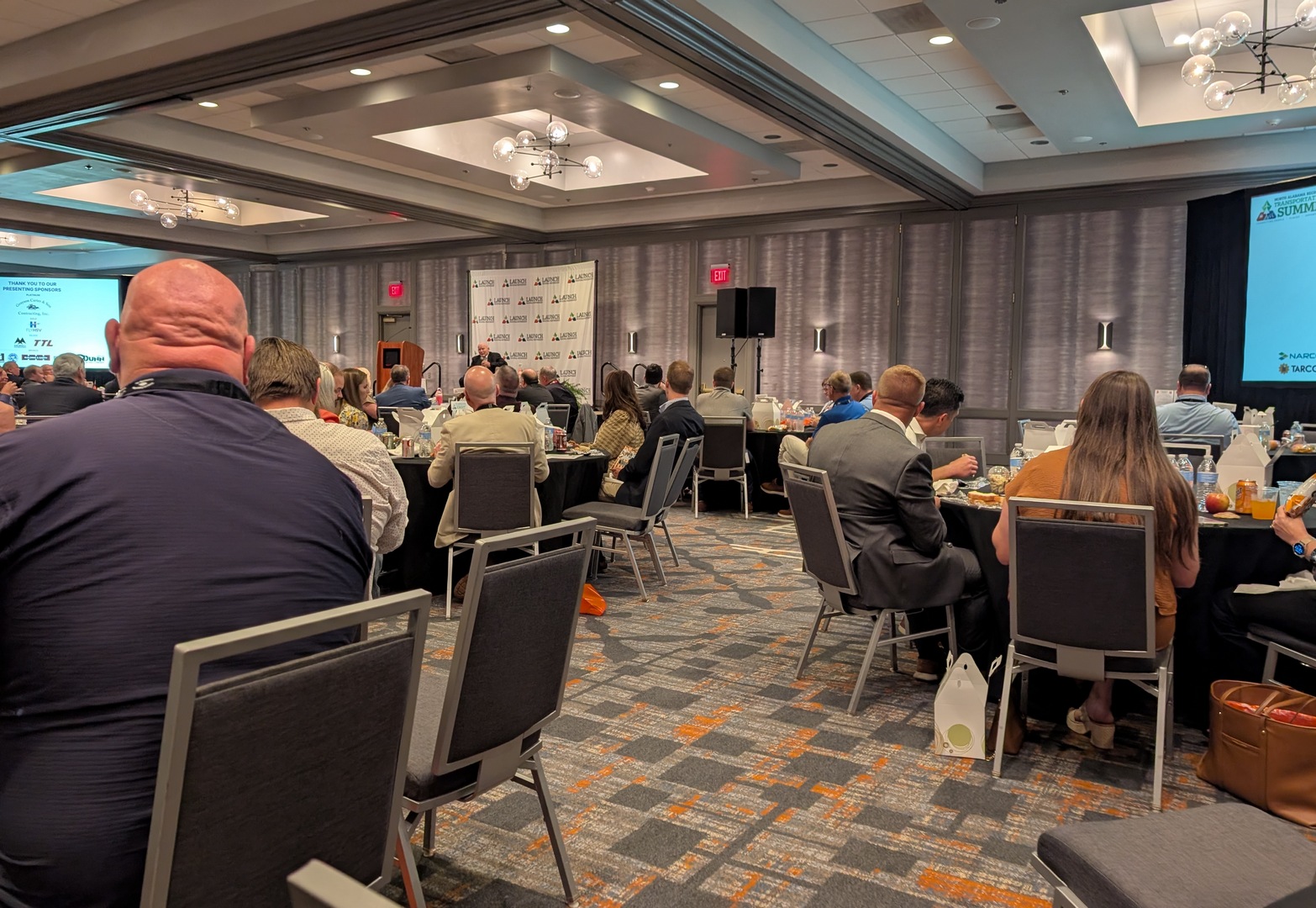
This panel began with Cooper discussing his experience as the ALDOT director. He discussed a lot about the challenges with improving transportation in Alabama. The two biggest challenges he sees is low taxes and political pushback.
Cooper talked repeatedly about how many projects can simply not be funded with how low our taxes are, and that there is little desire from residents to increase taxes to pay for transportation improvements. While the gas tax has stayed the same since 1997, construction costs have skyrocketed and more fuel efficient cars have come onto the market. The gas tax has not been able to keep up with costs, and with there being pushback from residents and politicians to raise taxes, many improvements can not be funded.
According to Cooper, the main reason the state doesn’t fund transit projects is because our elected officials don’t want to fund public transit. Its not a matter of not having the funds, its a matter of disinterest. When faced with the opportunity to improve public transit with a 80:20 federal grant match, the state turned it away. Even with an 80% discount, the state rather use every dollar repairing and expanding roadways.
Speaking of expanding roadways, Cooper mentioned a concept that is well known among Strong Towns supporters and other urbanists: Induced demand. He explained induced demand and gave examples of where he has seen it in action, but, as he explained, with government leaders not having interest in alternatives to driving, the only thing they can do is continue to expand roadways, even if that doesn’t solve traffic problems in the long run.
Regarding bike lanes, he feels that its hard to justify spending the money on them since he never see cyclists use them. I actually biked to this event using the bike lane on Governors House Drive.
Its not surprising that someone who doesn’t bike never sees cyclists. Most bike lanes are not built along busy car corridors, rather, they are built on low traffic roads or even in the middle of forests. If you watch my youtube videos, you’ll know that a lot of people use the bike lanes in Huntsville!
To summarize this panel, if we want better roads, we need residents to accept higher taxes. If we want more public transit, we need politicians who want public transit. If we want more biking infrastructure, we need to show ALDOT the number of cyclists who use currently use biking infrastructure.
Final notes
The event was great and was well received by other attendees. A great breakfast and lunch was provided, and the venue was great.
The event achieved its purpose of gathering professionals to network and discuss transportation in North Alabama. This is expected to be a yearly event.
If you’d like to see us continue to report on local events like these, please subscribe to our newsletter!

 Strong Towns Huntsville
Leave a comment