The following is an article written by Caitlin Moore with minor edits by Nick Frevold.
“How many crosses on the side of the road do we need to see before changes are made?” a friend asked me the other day. I had just finished telling her about how my son was almost hit by a car as he was trying to make his way to the other side of the road on his bike. He’s fine thank goodness, but it was too close of a call.
I agree with my friend. It feels like every road has a little memorial site, a cross usually, or a pile of stuffed animals. It’s a reminder that a life was lost at this spot due to a vehicle collision.
My mind goes to the recent tragedy of 13 year old Kal Fox, of Huntsville. In fact, I realize it’s been a year; he was killed August, 5″, 2025. He was legally crossing a road, biking on the crosswalk, yet was struck and killed by a woman driving recklessly. A few months ago a permanent memorial bench was dedicated near the intersection on Bailey Cove Road where he died. The driver was arrested and charged with reckless murder in connection to the incident.
Still, I imagine none of this is much comfort to Kal’s parents and friends and family. I’m a mom of three boys, ages 17, 15, and 11.
Nothing could comfort me if anything were to happen to them. That is why the close call of my middle son being almost struck due to reckless driving has shaken me to my core. It’s lit a fire under me to take some kind of action.
I’m a stay-at-home mom, and I try to give my kids reasonable amounts of freedom.
My 15 year old follows the rules on the road as he bikes with friends, wearing his helmet, using the crosswalks, and waiting his turn.
He even wears a reflective vest when it gets a little dark and has a light on the front of his bike.
The problem though, is that between a car and a bike, the car will always win when it comes to a collision. The car that crashes into you doesn’t care that you followed the rules. Even if it’s truly an accident. A vehicle is essentially a death machine in the hands of too many reckless drivers who have no idea of their responsibility.
We all know that people in Huntsville speed regularly. Many drive under the influence. If they get away with this behavior long enough it reinforces that they should continue.
This may sound melodramatic, and I may sound angry. Well, I am angry, and frankly I’m trying to get your attention.
My son was walking his bike across the road, waiting for the “walk” signal on a crosswalk island. A vehicle ran a red light and collided into another vehicle that couldn’t stop in time. This second vehicle missed my son by mere inches, and my son’s bike was flattened. Somehow, no one was injured.
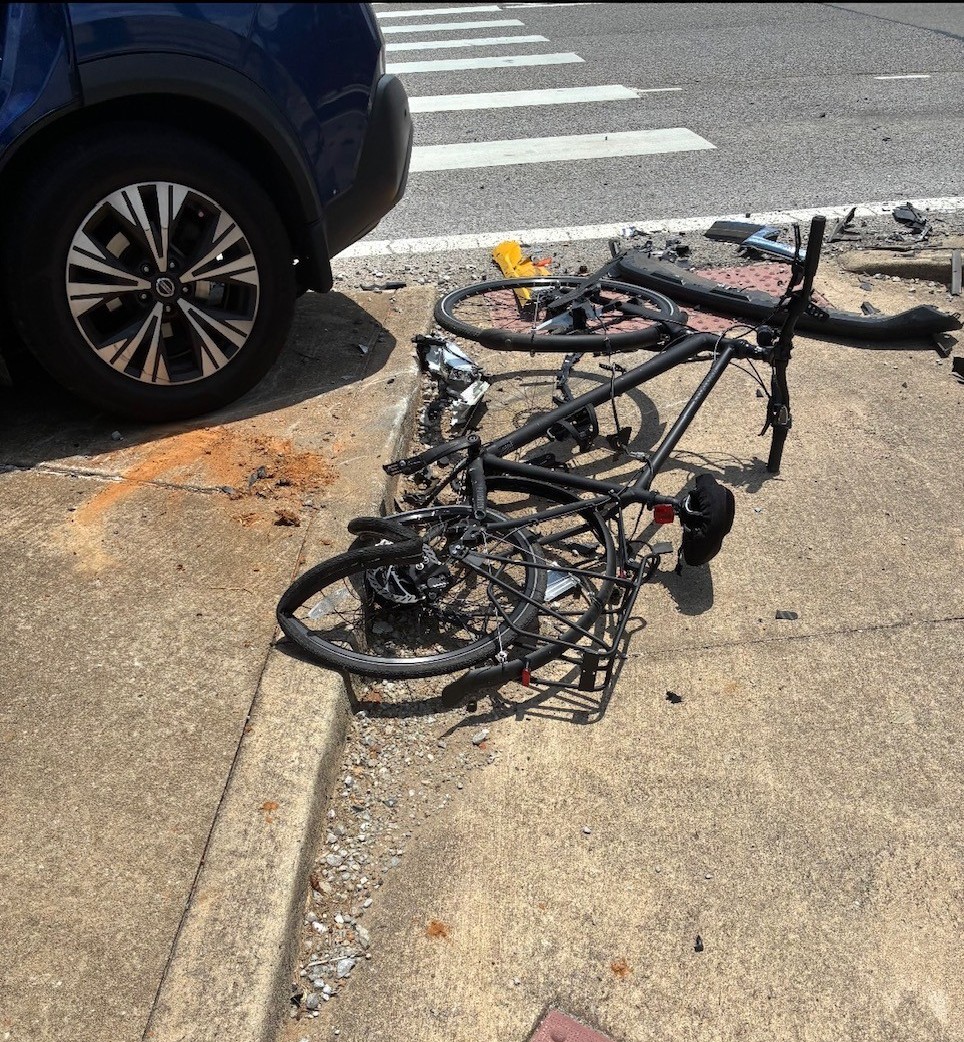
Both vehicles were totaled. My husband and I couldn’t sleep that night thinking about what could have happened.
There are a few things during that scenario that really surprised me. First of all, the police officers at the scene didn’t know that there were pedestrians (my son and a friend) involved. The officers were under the impression that the smashed bike belonged to one of the drivers, and flew off the vehicle.
The officers didn’t approach my son and his friend to ask about the accident at first. The only reason they did was because my husband showed up in time to advocate for them. Remember, my son is only 15, and he was waiting for an adult in charge to help.
l’ve since learned that the Huntsville police department is stretched so thin right now, that despite Huntsville’s growth, the police force is shrinking.
The other thing that surprised me is that the wreck was cleaned up very quickly; no one would have known a vehicle collision happened there an hour prior.
That brings me to my first idea: temporary signs placed at the sights of all car accidents. Each sign would have very sparse information, just the date and time of a vehicle collision, but it would grab attention in bold colors or lettering. It would say, “On this date of _ there was a vehicle collision.”
The sign would be very large print and easy to see from the road.
The theory is that if drivers see how many car collisions happen around us all the time, it may send a reminder to be more careful.
But I want to emphasize that the word “collision” be used, and not “accident” When we call collisions “accidents” that implies that they cannot be avoided and there was no fault on any driver.
I don’t know how this could be implemented practically, but I wanted to bring this idea to any listening ears.
I also wanted to share a little about a 2018 study about the failure of drivers to yield to pedestrians.
It was done by a research psychologist named Nichole Morris at the University of Minnesota.
In St. Paul, MN at this time, there was a police effort to improve safety for pedestrians. A campaign was carried out, and plain clothes police also posed as pedestrians to pull over drivers that failed to yield.
Still, the yielding rate wasn’t good at all even after those efforts; only 32% of drivers complied with the law. So, what Nichole Morris and her team wanted to do was see if they could improve driver yielding not with laws and enforcement, but with tricks from the field of human psychology.
During this experiment, it was shown that if the right strategy is implemented, it can indeed improve safety and driver yielding.
One strategy was a pair of signs.
The signs looked like regular traffic signs, and they displayed the yielding rate from the previous week.
Every week, Morris and her team updated the signs with the numbers they had recorded.
What these signs did was imply surveillance and this encouraged people to yield. It drew on the principle of social pressure. For example, the first week the sign said
“Percent of drivers stopping for pedestrians
– last week: 43%, Record 45%”
The signs got much attention from civilians and the media that August of 2018 in St. Paul.
The yielding rate of drivers was improved dramatically after a few weeks of using methods from behavioral psychology. At the end of the experiment the pedestrian yielding rate rose to 72%. Also, the number of drivers who were passing yielding drivers fell to just 1 percent.
My second idea is to use brightly colored paint and inexpensive plastic bollards on intersections. This isn’t a new idea; it has been done by people who practice tactical urbanism.
Tactical Urbanism is a low cost approach to making public spaces safer for pedestrians and bicyclists. This is done with temporary methods; an experiment.
Too many suburban areas are designed for cars and not for pedestrians. Painting the cross walks in bright colors and placing visual cues like signs and bollards make the street feel different and when streets feel different people instinctively slow down.
Vehicles will slow down because they have increased awareness.
At the intersection where my son was almost hit recently, is a busy road with many residential neighborhoods connected to it.
There is a school, a church, a recreation center with a playground and soccer field, and a new day care is about to be opened as well.
There is a speed limit, and sidewalks, and cross walks, and stop signs and stop lights, yet despite all this…I don’t feel like my boys are safe to ride their bikes on this main road anymore.
Personally, I have taken action in every way I know how. Again, I don’t have any job title unless “Mom” counts. I’ve gone to Huntsville City Hall to talk about my ideas, and I’ve been in contact with certain city council candidates. I’ve gone back and forth with the Huntsville Police Department and the Traffic Engineers. I’ve put requests in with ALDOT for protected intersections. I’m going to keep up my correspondence.
So far, the solutions I have been given are to have patrolling police officers more often on our main road. Also I was advised to request temporary LED signs to show the speed of passing traffic. (Our road doesn’t meet the criteria of a permanent LED sign l’ve learned).
Yes, most everyone slows down when they see a police car nearby. It works, but only as long as the police car is situated there.
I’m not actually asking for more patrol cars and law enforcement. Im not asking for a lower speed limit. I’m asking for the roads to be renovated via inexpensive methods that grab the drivers’ attention, thus keeping pedestrians safe.
In the meantime, I see vehicle collisions every day around where we live. My kids haven’t touched their bikes in a month since my son’s bike was smashed.
We cannot wait for more public transportation to become available or affordable or for speed limits to go down, or for laws to change.
It seems to me that changes only happen after a tragedy. There are too many crosses on the side of the road.
There must be inexpensive, short-term action done by volunteers like us to make it happen. It can happen with simple signage, bright paint and plastic bollards, and methods used by behavioral psychologists.
Drivers need reminders and they must feel more social pressure so our citizens and our children may all actually move through our towns and cities more safely. I would like to work with the City of Huntsville to help accomplish this.
If you would like to submit your own story, send an email to contact@strongtownshuntsville.org


Leave a Reply