If you read news articles or comments on social media, you’d think Huntsville is just a few years away from becoming the largest city in America, but its not even close. It may be bigger than all the other small rural towns in Alabama, but from national or global scale, Huntsville nowhere close to being a large urban city.
Population and growth
First we can look at population. Huntsville struggles to stay within the top 100 largest cities in America, ranking between #107 and #100 with each year’s census updates. Looking at the metro area, it doesn’t rank any better.1
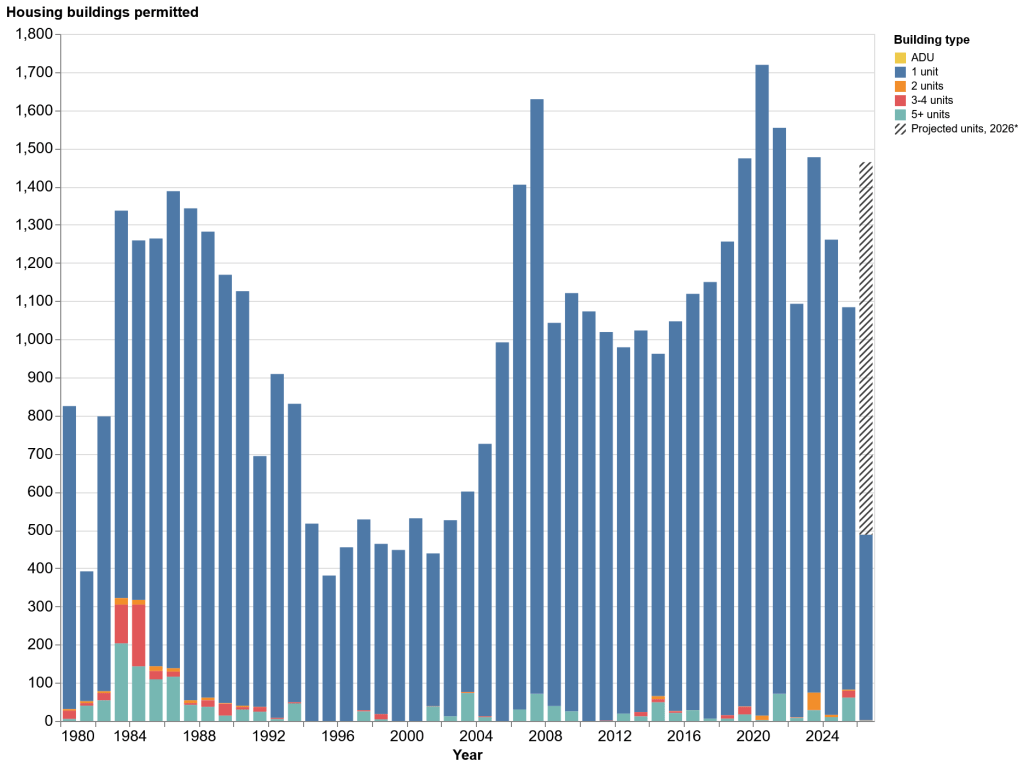
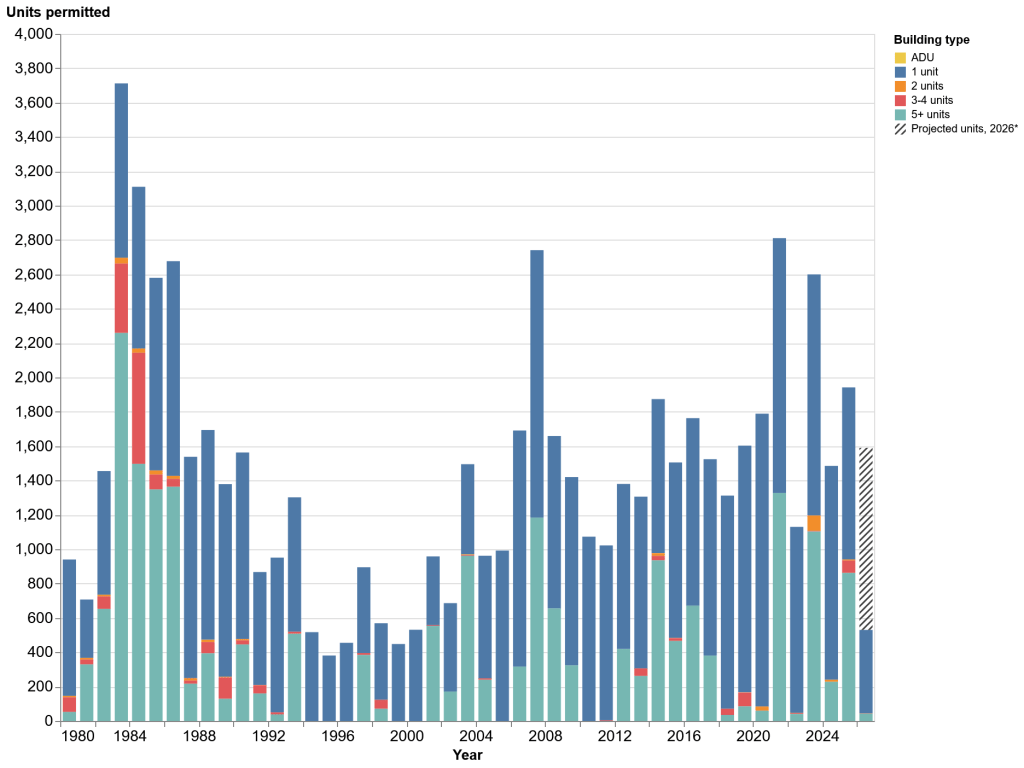
While its true Huntsville had a growth spurt between ~2014 and 2024, that growth has slowed in more recent years. Construction of multi-family homes (apartments, townhomes, etc.) has fallen dramatically since 2024 and is expected to continue to fall. By %, Huntsville is growing at a slower rate than Madison and Athens. This means most of the growth within the metro area is coming not from within the city, but from the suburbs. When looking at growth rate between 2020 and 2025, Huntsville is ranked only the 45th fastest growing city with a population above 100,000.
Compare the growth of another southern city like Austin, TX to Huntsville and you’ll really see how relatively slow Huntsville is growing. It took Austin 20 years to go from 130,000 people to 250,000 people. Huntsville still has not reached 250,000 people 55 years later.
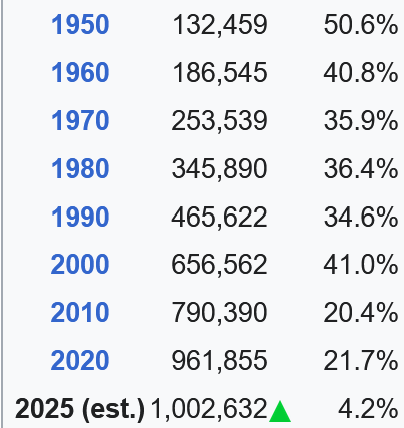
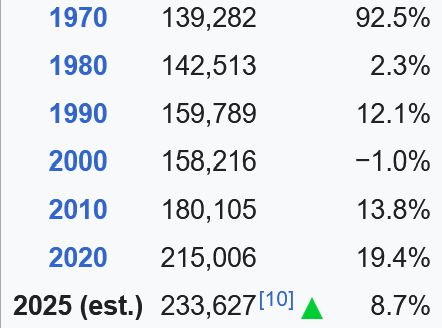
This is all to say that, while Huntsville is indeed growing, its not growing at a particularly noteworthy rate.
Density
A defining difference between a rural town or suburb compared to a big city is its density. Of the 348 cities in America with a population over 100,000, Huntsville ranks #337.
When you compare Huntsville’s urban area, ignoring city borders and undeveloped land, and rank it among the 510 urban areas with above 50,000 people, Huntsville ranks #401.
Despite the commonly held belief that “apartments are popping up everywhere!”, Single family homes are, by far, the most common new housing built in Huntsville. >90% of new buildings are single family homes, and even by unit count, >50% of housing units are single family.2
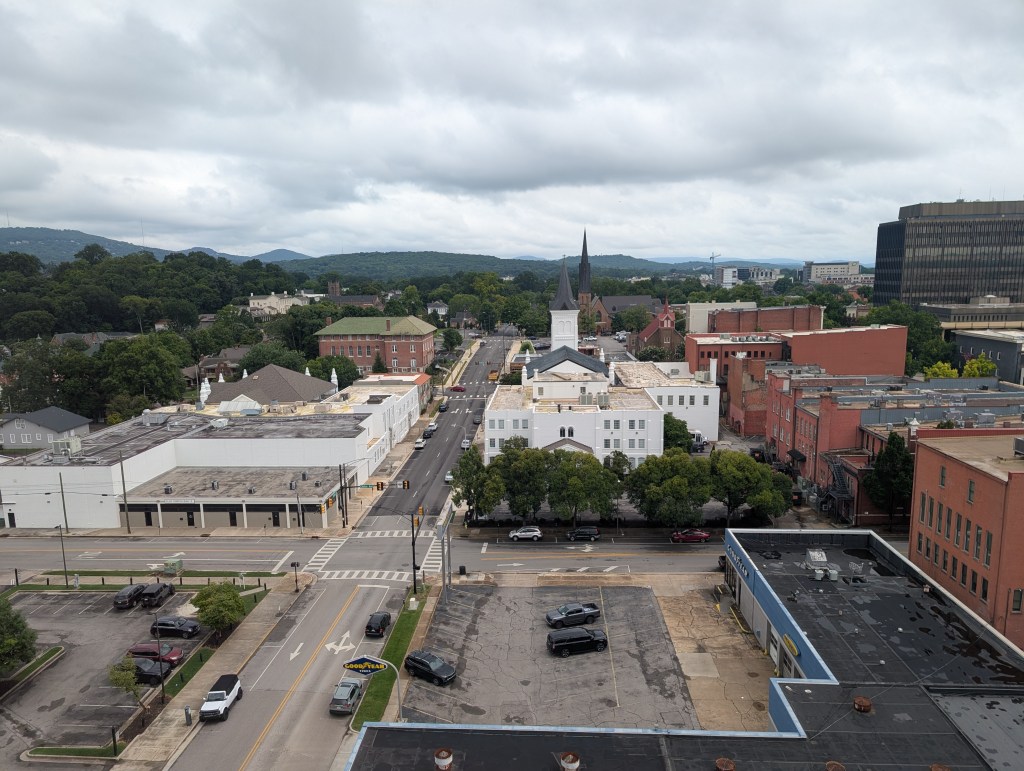
Huntsville does have pockets of density. Midcity, downtown, and Stovehouse have all seen significant increases in density. But these are just small unconnected pockets in a very spread out city. Downtown and Stovehouse sit across from low density single family homes, and Midcity sits along a deadly highway in a low density office park.
Unlike a large density populated city, you rarely see a large number of people walking around. The square where Madison county courthouse is located and the connecting Big Spring Park are the only places in all of Huntsville that you’ll regularly see more than a small handful of people gathered at all times. Everywhere else in Huntsville is about as alive with people as a small rural town.
Pedestrian, bike, and transit focused developments
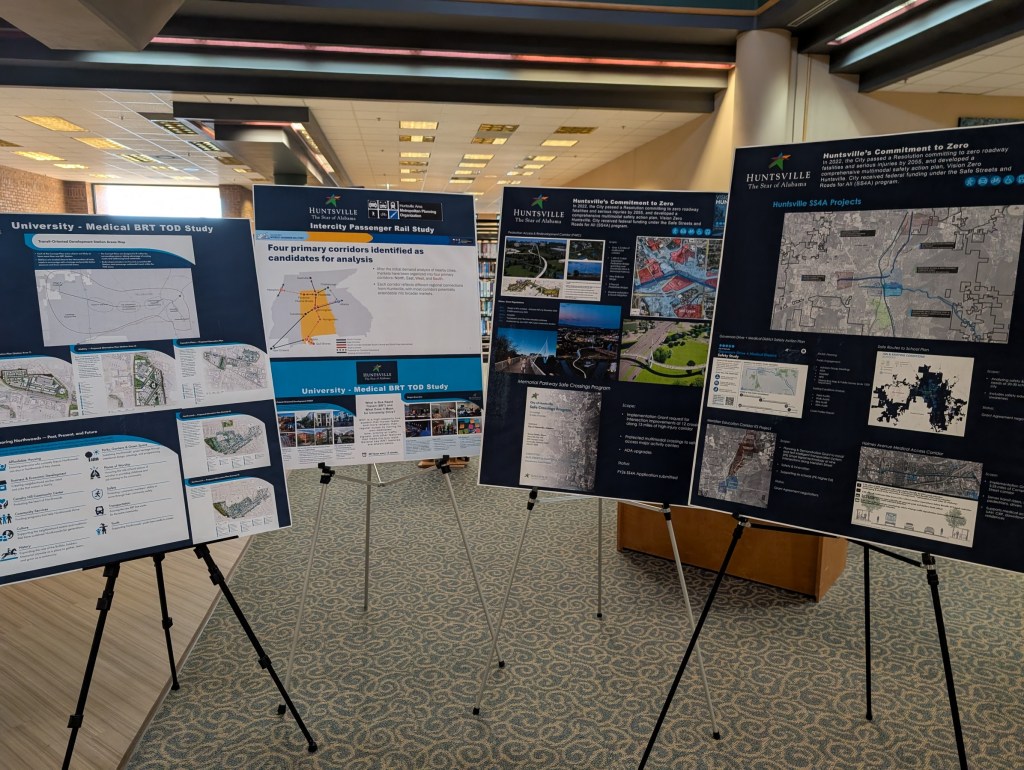
If you look at the Huntsville MPO, roughly $1 billion will be spent in the next few years to upgrade road infrastructure for drivers. Only around $100m will be used to upgrade infrastructure for pedestrians, cyclists, and transit riders.
In large cities, bike lanes are built to connect neighborhoods, schools, and other amenities to allow a more efficient mode of transportation. Bikes allow quicker and more convenient travel compared to cars, which are more bulky and required more space to park.
In Huntsville, bike lanes largely do not connect to anything. They are largely constructed as just recreational paths. In the few areas in which bike lanes are placed on roads in urban environments, they are very short distances and only placed on roads which have very low car traffic anyways. The Sky Bridge and Holmes Ave bike paths could be exceptions to this, but those projects are still years away from being completed.
While other cities the size of Huntsville have passenger light rail, such as Norfolk, VA and Buffalo, NY, Huntsville is unlikely to get even proper rapid bus transit. Large cities have buses with 5 to 15 frequency with dedicated bus lanes and multiple passenger rail options.
In large cities, transit is built alongside new developments. In Huntsville, even new densely populated developments like Westmoore Landing have no mention of transit connections.
Development of Huntsville is largely not like that of a growing large city, but more similar to that of a small town. When looking at developments in Huntsville, I’m much more reminded of my home town of Rogersville, AL rather than a big growing city like Seattle, WA.
Global brands
When it comes to retail and entertainment, Huntsville lacks a lot compared to large cities. For international food and retail, Atlanta has countless more options than what we have in Huntsville. While we have a small amount of korean grocery stores, most of these stores get their products from Atlanta. Unlike large cities, Huntsville is not a primary market for entertainment or retail brands.
Huntsville doesn’t have major brands/businesses like DAISO, Uniqlo, MIXUE, H-Mart, Nandos, and others. Many of the global brands that have come to Huntsville recently, such as Ikea, are scaled down versions of their regular stores. Huntsville lacks “flagship” stores.
For entertainment, most major musicians and bands avoid Huntsville and instead perform at Nashville or Atlanta. Huntsville not only lacks the population, but also lacks the infrastructure to host major entertainment events. Lack of public transit and small event spaces provide little room for major performers and large audiences.
Future growth
Huntsville’s future is not that of a large city, but a medium sized city. In the next 10 years, Huntsville will likely continue to grow into a medium sized city. Incremental change will happen, but with the attitudes and vision of residents, council/mayor, and state level politicians, its unlikely we’ll see Huntsville turn into a large urban city before the end of the century.
Huntsville is not a small rural town, but its not a large city either, and won’t be one for some time.
- Using census data. According to the city’s officially data, the population is around 250,000 people. While it could be true the census is under-counting Huntsville’s population, I’ve noticed this under-counting appears to be common among most other cities too, so its unlikely to affect the comparisons very much. ↩︎
- https://housingdata.app/places/AL/Huntsville ↩︎



Leave a Reply